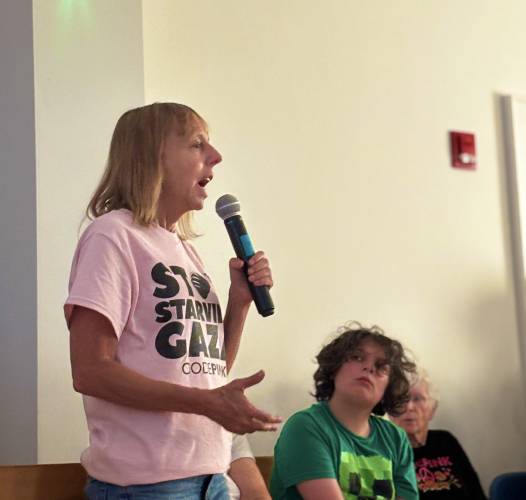
Medea Benjamin, co-founder of Code Pink, the feminist grassroots organization working to end U.S. wars and militarism, speaks last week in the Northampton Friends Meetinghouse. STAFF PHOTO/SAMUEL GELINAS
NORTHAMPTON — Times are changing and so are sentiments around the conflict in Gaza, according to two front-line experts who gave a window into the ever-evolving political narratives surrounding Israel and the West Bank in a forum last week.
Medea Benjamin, co-founder of Code Pink, the feminist grassroots organization working to end U.S. wars and militarism, and Ann Wright, a 29-year U.S. Army veteran and former U.S. State Department official, came to the Northampton Friends Meetinghouse to speak before a crowd of about 70 people on Monday. The activist leaders described the situation in Gaza as “genocide,” and called for an instant cease-fire.Support for Israel down
Benjamin made the case that while public opinion is shifting on support for Israel, votes by U.S. lawmakers are not changing. The country receives almost unanimous votes for funding from both Democrats and Republicans.
For her, this is a crisis in the democratic political process that she sees playing out everyday in D.C.
“It is just pathetic the way we are not represented by a government that is supposed to represent us,” Benjamin said, which has led to feelings of “cynicism” within progressive circles.
Benjamin blames money and power for the situation, specifically the American Israel Public Affairs Committee, or AIPAC, a pro-Israel lobbying group that she said demonizes pro-Palestinian legislators.
Among Democrats, Benjamin cites two examples to make her case — Reps. Jamaal Bowman of New York and Cori Bush of Missouri.
Bowman, after four years in Congress, was defeated in his June 2024 primary by George Latimer, a candidate supported by AIPAC. Pro-Israel groups reportedly spent millions of dollars on ads and mailers against Bowman. Bush lost her primary in August 2024 to Wesley Bell, whose campaign received substantial funding from AIPAC and other pro-Israel groups.
On the Republican side, President Donald Trump threatened to help defeat Kentucky Congressman Thomas Massie in his primary based on Massie’s view that Israel is not an ally.
But while Washington is holding strong in support of Israel, popular opinion is not.
Benjamin referenced data collected by polling organization Gallup, which has reported that support for Palestinians is at its highest point in the past 25 years of polling conducted on the topic.
Their findings showed that, “Although Americans remain more likely to say their sympathies in the Middle East situation are with the Israelis rather than the Palestinians, the 46% expressing support for Israel is the lowest in 25 years of Gallup’s annual tracking of this measure on its World Affairs survey. The previous 51% low point in this trend of Americans’ sympathy for Israelis was recorded both last year and in 2001.
“At the same time, the 33% of U.S. adults who now say they sympathize with the Palestinians is up six percentage points from last year and the highest reading by two points,” the Gallup study noted.
But the demonization goes deeper than super PAC money, said Benjamin.
“They try to demonize our groups, our students, people who are standing up,” she said to a room full of those who have been protesting and voicing support for the Palestinian cause.
Code Pink itself has been on the front lines of persecution for its stance, as the group faces a lawsuit for “supporting terrorists,” namely Hamas.
“There are these ridiculous rumors that Code Pink is financed by the Communist Party of China, sometimes it’s by Iran, sometimes by Russia, whatever. But, you know, we laugh about it,” Benjamin said.
Nonetheless, lawsuits “sap a lot of time and energy and money from organizations,” she said.
Wright, who’s home is in Honolulu, has been on the front lines of the international scene, and recently was on a Gaza Freedom Flotilla, a coalition of civil society organizations that aims to challenge and break the Israeli blockade of the Gaza Strip through nonviolent direct action by sea.
“Ten days ago we sailed yet another boat called the Honduras with 21 passengers on board,” including high-ranking officials from various countries, Wright said. “It was stopped by the Israeli military five days ago. It was only about 50 nautical miles offshore. I think it was because the Israeli military told their higher-ups we don’t like to stay on board with those activists.”
Wright experienced a similar situation about seven weeks ago. That time, Greta Thunberg, the now 22-year-old climate activist, was on board.
On June 9, their ship was intercepted by the Israeli military in international waters and diverted. Thunberg, along with other activists onboard, was detained and later deported from Israel. She was forced to take a plane back — something she is known to avoid due to her views concerning the climate crisis.
This is just another form of demonization, said Wright.
“Bottom line is we will continue to sail these boats until Palestine is free, until we can get our government to stop its complicity with Israel on genocide and ethnic cleansing,” said Wright.
Both Benjamin and Wright called it “ridiculous,” to say that starvation in Gaza is Hamas’ fault, citing a recent U.S. Agency for International Development (USAID) study that concluded there are “no reports alleging Hamas” benefited from U.S.-funded food supplies.Shifting landscape
It’s not just Gallup polls that are documenting a shift in sentiment toward Israel. Benjamin noted that the conservative podcast culture, including Tucker Carlson, has been challenging America’s allegiance to Israel. And the White House is also generating confusion on the subject of Israel.
“I think that there is real division in the White House — tremendous division,” she said. “Trump brought in hawks, and he brought in people that wanted to use diplomacy”
She continued, “So they’re fighting with each other, and Trump changes his mind every single minute, so you never know what he’s thinking.”
Among mainstream Republicans, she said, many are evangelical Christians, which drives their almost unquestioning support for Israel. However, with recent events, even they have had some concerns.
The bombing of Gaza’s Catholic Church and other churches has “sparked a lot of discontent” in conservative circles, she said.
“They’re saying, ‘What the heck is this about? You talk about American first, and it’s really Israel first,” she said.
While Republicans are ironing out their differences, the political left is also getting a makeover.
While the Democratic Party is going through a “generational crisis,” Benjamin aid there is evidence of new pro-Palestinian energy coming out of the American left — led by Zohran Mamdani, the 2025 Democratic candidate for mayor of New York who received the largest applause of the night in the meetinghouse.
“New York City is the No. 2 city in the world for the Jewish population, after Tel Aviv, and there are lots of Jews who have been campaigning for Mamdani, who really love him,” she said, while also highlighting the fact that the Democratic Party “doesn’t know what to do with him,” due to both his domestic views on affordability, but especially his pro-Palestinian sentiments.
Internationally, Jeremy Corbyn, a leader of the British Parliament, is leading the way. After his 2024 expulsion from the Labour Party, the party he had been a member of since 1965, he decided to begin his own political movement after being called “antisemitic” for his pro-Palestinian beliefs.
“He probably wouldn’t call it revenge but he has taken his revenge” in the form of leaving the Labour Party, Benjamin said. “He just declared less than a week ago that he was going to start a new party, and one of the planks of the new party is to support Palestine.” Thus far, he has received 500,000 interested in participating in his party, which has yet to be named.
“Between Mamdani and Jeremy Corbyn … it shows the thirst that people have in the so-called Western democracies to have something very different than the governments we have now,” Benjamin said. “We might reflect on how we can do something similar here in the United States.”
Samuel Gelinas can be reached at sgelinas@gazettenet.com.